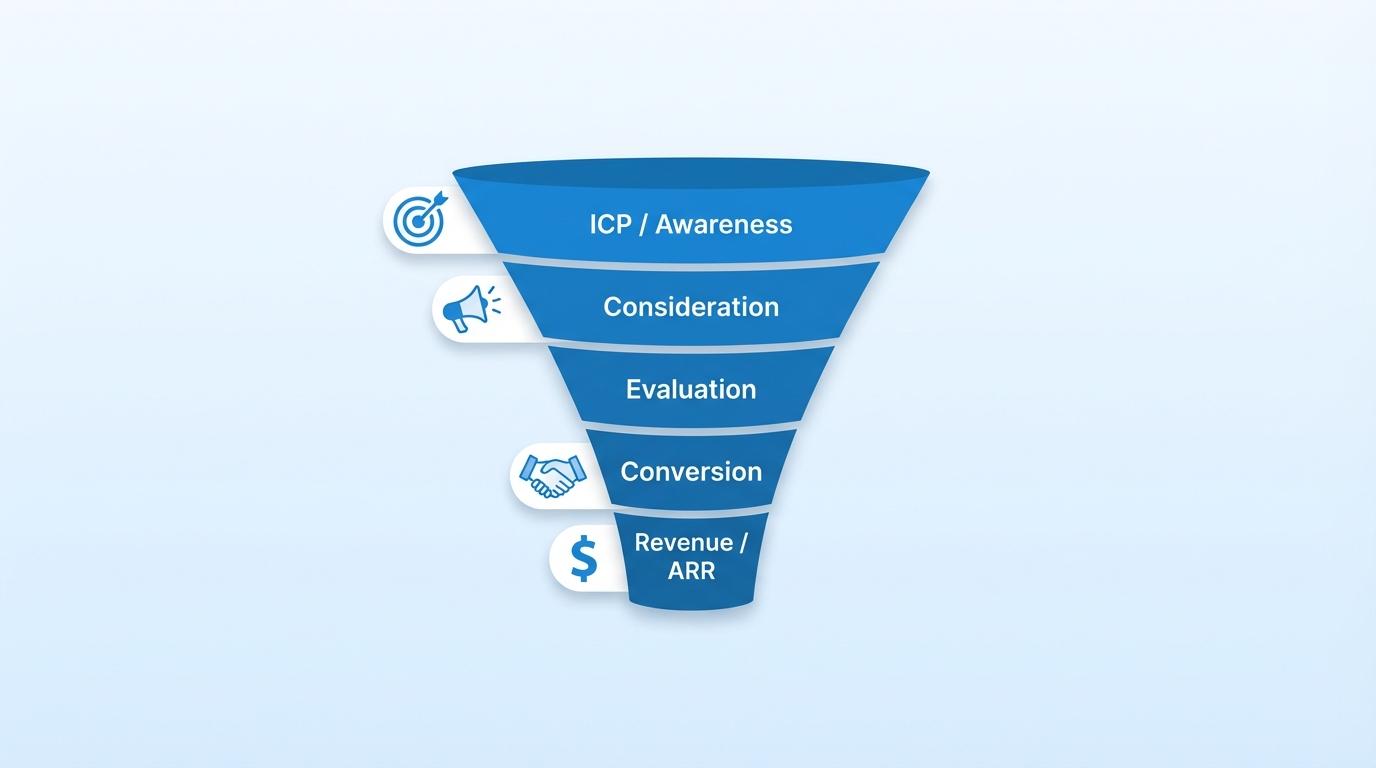
GTM Strategy for B2B SaaS Under $5M ARR
A go-to-market (GTM) strategy for B2B SaaS defines how you identify, reach, and convert your ideal customers. Under $5M ARR, most companies don't have a true GTM strategy — they have a collection of tactics that worked early and are now showing diminishing returns.
This post provides a practical framework for building a structured GTM strategy at the $500K–$5M ARR stage, including how to define your ICP, select channels, build your motion, and measure progress.
What a GTM Strategy Actually Is (and Isn't)
A GTM strategy is not:
- A list of marketing tactics
- A positioning statement
- A 40-slide deck
- A plan to "do more content" or "run paid ads"
A GTM strategy is:
- A defined set of target buyers (ICP)
- A clear articulation of why you win with those buyers (positioning)
- A prioritized set of channels to reach them
- A defined sales motion (how you convert interest to revenue)
- A measurement system to track and optimize
Most B2B SaaS companies under $5M ARR are missing at least three of these five components. The gap between where you are and where you need to be on each component is your GTM gap.
Step 1: Define Your ICP With Precision
The Ideal Customer Profile (ICP) is the single most important input to your GTM strategy. Everything downstream — messaging, channels, sales motion, pricing — flows from a precise ICP.
Firmographic Attributes
Start with the objective characteristics of your best customers:
- Company size — number of employees, revenue range
- Industry — specific verticals, not broad categories
- Technology stack — what tools do they already use?
- Geography — if relevant to your go-to-market
- Business model — B2B vs B2C, enterprise vs SMB, transactional vs subscription
Psychographic Attributes
Go beyond demographics to understand the buyer's internal world:
- Primary pain — what problem are they urgently trying to solve?
- Previous attempts — what have they tried before, and why did it fail?
- Success metric — how do they define a win from your product?
- Risk tolerance — are they early adopters or late majority?
- Decision-making style — data-driven, consensus-driven, executive-led?
Trigger Events
The best GTM strategies are built around timing. Trigger events are the moments when your ICP is most likely to be actively looking for a solution:
- Recently raised funding — new budget, pressure to scale
- New marketing hire — new leader, blank slate, wants quick wins
- Leadership change (new CMO/CEO) — new leader wants to put stamp on org
- Rapid headcount growth — systems breaking under scale
- Missed growth targets — board pressure creates urgency
- Competitor just launched — fear of falling behind
The most effective outbound and ABM programs are trigger-based. Rather than blasting a cold list, you're reaching prospects at the exact moment they are most likely to buy.
90-Day GTM Execution Checklist for B2B SaaS <$5M ARR
Below is a concise, execution-ready checklist derived from the GTM framework you outlined. You can use it as an internal playbook or onboarding doc for GTM leaders.
1. ICP: Define With Precision
1.1 Firmographics (2–3 core segments)
- [ ] Company size (employees, revenue range) clearly defined
- [ ] Industry narrowed to specific verticals (not broad categories)
- [ ] Tech stack documented (key tools, data sources, adjacent platforms)
- [ ] Geography constraints/priority regions defined
- [ ] Business model clarified (B2B/B2C, SMB/mid-market/enterprise, transactional/subscription)
1.2 Psychographics (per segment)
- [ ] Primary pain articulated in the customer’s own words
- [ ] Previous attempts and why they failed documented
- [ ] Success metrics defined (how they measure a win)
- [ ] Risk tolerance profiled (early adopter vs late majority)
- [ ] Decision-making style mapped (data-driven, consensus, exec-led)
1.3 Trigger Events (3–5 high-intent signals)
- [ ] Funding events (e.g., Seed/Series A/B) tracked
- [ ] Key hires (e.g., new CMO/VP Marketing/RevOps) monitored
- [ ] Leadership changes (CEO/CMO/Head of Ops) monitored
- [ ] Rapid headcount growth or new office openings tracked
- [ ] Missed growth targets / public signals of pressure tracked
- [ ] Relevant regulation or industry shifts tracked
1.4 Buying Committee Map
- [ ] Economic buyer identified (title, goals, objections)
- [ ] Champion/user identified (day-to-day pain, success metrics)
- [ ] Influencers identified (IT, security, finance, ops, etc.)
- [ ] Procurement/legal stakeholders mapped
- [ ] Typical approval path and deal stages documented
1.5 Anti-ICP Definition
- [ ] Clear list of segments you will NOT sell to (size, industry, tech, budget)
- [ ] Disqualifying criteria for outbound and inbound documented
- [ ] SDR/AE playbook updated with anti-ICP rules
2. Positioning & Messaging
2.1 Core Positioning (Answer the 5 questions)
- [ ] Who is this for? (exact ICP segment, not “all B2B”)
- [ ] What problem do we solve? (urgent, specific, painful)
- [ ] What is our solution? (how we uniquely solve it)
- [ ] Why do we win? (proof: data, methodology, unique capability)
- [ ] What is the alternative? (status quo + main competitors)
2.2 Positioning Statement (1–2 sentences)
- [ ] Drafted in plain language, not jargon
- [ ] Names the ICP explicitly
- [ ] States the primary pain and outcome
- [ ] Differentiates from spreadsheets / generic tools / main competitor
- [ ] Reviewed with 5–10 customers/prospects for resonance
2.3 Messaging Hierarchy
- Tier 1 – Category Narrative
- [ ] Clear story: why this problem matters now
- [ ] Tied to macro trends (market, tech, regulation, buyer behavior)
- [ ] 1–2 core narrative docs (internal + external version)
- Tier 2 – Value Propositions (3–5)
- [ ] Each value prop is specific, outcome-oriented, and provable
- [ ] Each mapped to a primary pain and success metric
- [ ] Prioritized (top 3 that consistently win deals)
- Tier 3 – Feature Proof Points
- [ ] Features mapped to each value prop
- [ ] Screenshots, demos, and customer quotes attached
- [ ] Competitive comparison notes (where we’re stronger/weaker)
2.4 Asset Alignment
- [ ] Homepage copy updated to reflect positioning
- [ ] Decks, one-pagers, and demo scripts aligned to hierarchy
- [ ] Email sequences and ads use the same core messages
3. Channel Strategy (1 Primary, 1 Emerging)
3.1 Channel Evaluation (Score each 1–5)
For each potential channel (Outbound, Content/SEO, Partners, Community/Events, PLG, Paid, etc.):
- [ ] ICP reach (can we reliably find our ICP here?)
- [ ] Conversion quality (historical or benchmark data)
- [ ] Cost efficiency (estimated CAC)
- [ ] Compounding value (does it get easier/cheaper over time?)
3.2 Channel Selection
- [ ] 1 primary channel chosen (e.g., outbound, content/SEO, PLG)
- [ ] 1 emerging channel chosen for experimentation
- [ ] Written rationale for each (why this, why now, what we expect)
- [ ] Clear owner and weekly activity targets per channel
3.3 Channel Playbooks
- Outbound (if primary)
- [ ] ICP-based account list built with trigger events
- [ ] 2–3 core sequences (per persona) created
- [ ] Messaging personalized by trigger event
- [ ] Daily/weekly activity and meeting targets defined
- Content & SEO (if primary/emerging)
- [ ] 10–20 priority keywords mapped to ICP pains
- [ ] Content calendar for 8–12 weeks (topics, owners, publish dates)
- [ ] Lead capture (forms, CTAs) and nurture flows defined
- [ ] Distribution plan (email, LinkedIn, communities) documented
- Partners/Integrations (if primary/emerging)
- [ ] Target partner list (5–10) defined
- [ ] Co-marketing and referral motions outlined
- [ ] Marketplace listing requirements and timeline documented
- Community/Events (if primary/emerging)
- [ ] 3–5 priority communities/events identified
- [ ] Thought leadership topics and posting cadence defined
- [ ] Event follow-up sequences and offers prepared
- PLG (if primary/emerging)
- [ ] Free tier/trial experience mapped (onboarding, aha moment)
- [ ] Product signals for sales-assist defined (usage, team invites, etc.)
- [ ] In-app prompts and lifecycle emails created
4. Sales Motion Design
4.1 Choose Motion (based on ACV & stage)
- [ ] Founder-led (typically < $1.5M ARR, early validation)
- [ ] Sales-assisted (AE + SDR; ACV > ~$15K)
- [ ] PLG + sales assist (lower ACV, high volume, strong product)
4.2 Define Handoffs & Definitions
- [ ] MQL definition agreed (per channel)
- [ ] SQL definition agreed (BANT or similar, but simple)
- [ ] Clear handoff process: marketing → SDR → AE
- [ ] SLA for follow-up time and number of touches
4.3 Sales Process & Stages
- [ ] Standard opportunity stages defined (with exit criteria)
- [ ] Discovery call framework and questions documented
- [ ] Demo flow aligned to value props and ICP pains
- [ ] Proposal/quote templates created
- [ ] Objection handling and competitive battlecards created
4.4 Content by Funnel Stage
- [ ] Top-of-funnel: educational content mapped to category narrative
- [ ] Mid-funnel: case studies, ROI stories, comparison pages
- [ ] Bottom-of-funnel: proof (security, integration docs, pilots, trials)
5. Measurement & Reporting
5.1 Core Metrics Defined
- Leading indicators
- [ ] MQL volume by channel
- [ ] MQL → SQL conversion rate
- [ ] Pipeline created (new opp $ by channel)
- [ ] Sales cycle length trend
- Lagging indicators
- [ ] New ARR by channel
- [ ] CAC by channel
- [ ] CAC payback period
- [ ] Win rate by competitor and by segment
- Health indicators
- [ ] MQL → SQL conversion trend over time
- [ ] Sales cycle length trend by segment
- [ ] Churn and expansion by acquisition channel
5.2 Attribution & Infrastructure
- [ ] CRM configured with stages, fields, and required data
- [ ] UTM standards defined and enforced
- [ ] Lead source and campaign fields validated
- [ ] Dashboards created for weekly, monthly, quarterly views
5.3 Reporting Cadence
- Weekly
- [ ] MQLs by channel
- [ ] Pipeline created
- [ ] Sales activity vs targets
- Monthly
- [ ] CAC by channel
- [ ] Conversion rates (MQL→SQL, SQL→Closed Won)
- [ ] Revenue vs target
- Quarterly
- [ ] Channel mix review and budget reallocation
- [ ] ICP validation (who closes/retains best)
- [ ] Win/loss analysis (by segment and competitor)
6. 90-Day GTM Launch Plan (Execution View)
Days 1–30: Foundation
- [ ] Finalize ICP doc (firmographics, psychographics, triggers, buying committee, anti-ICP)
- [ ] Complete positioning and messaging hierarchy
- [ ] Audit current channels, content, and funnel metrics
- [ ] Choose 1 primary and 1 emerging channel
- [ ] Set up CRM, tracking, UTMs, and core dashboards
- [ ] Align sales motion, MQL/SQL definitions, and SLAs
Days 31–60: Launch
- [ ] Launch outbound sequences to top ICP accounts (if outbound)
- [ ] Publish 4–6 core content pieces mapped to priority keywords/pains
- [ ] Implement lead capture (forms, CTAs) and nurture sequences
- [ ] Update website messaging and key sales collateral
- [ ] Run first A/B tests on homepage and key landing pages
- [ ] Start partner, community, or PLG experiments (emerging channel)
Days 61–90: Learn & Optimize
- [ ] Review outbound performance (reply rates, meetings, opps, wins)
- [ ] Analyze content performance (traffic, leads, influenced pipeline)
- [ ] Identify highest-converting messages, offers, and triggers
- [ ] Double down on best-performing segments and channels
- [ ] Refine ICP and positioning based on closed-won/lost insights
- [ ] Adjust activity targets and budget allocation for next 90 days
7. Common Pitfalls Checklist (Avoid These)
- [ ] ICP is specific and documented (not “B2B companies”)
- [ ] Positioning finalized before scaling spend
- [ ] No more than 2 active channels at meaningful investment levels
- [ ] Attribution in place before major budget increases
- [ ] Sales motion, definitions, and SLAs agreed across GTM team
Use this as a living document: review and update it every quarter as you learn which segments, messages, and channels actually drive efficient, repeatable ARR growth.
More frameworks like this, straight to your inbox
Practical B2B SaaS marketing — no fluff, no filler. Unsubscribe anytime.
Ready to fix your GTM?
Get a free personalized assessment of your marketing program — benchmarked against B2B SaaS companies at your exact ARR stage.
Get your Matrix score -> Book a Call