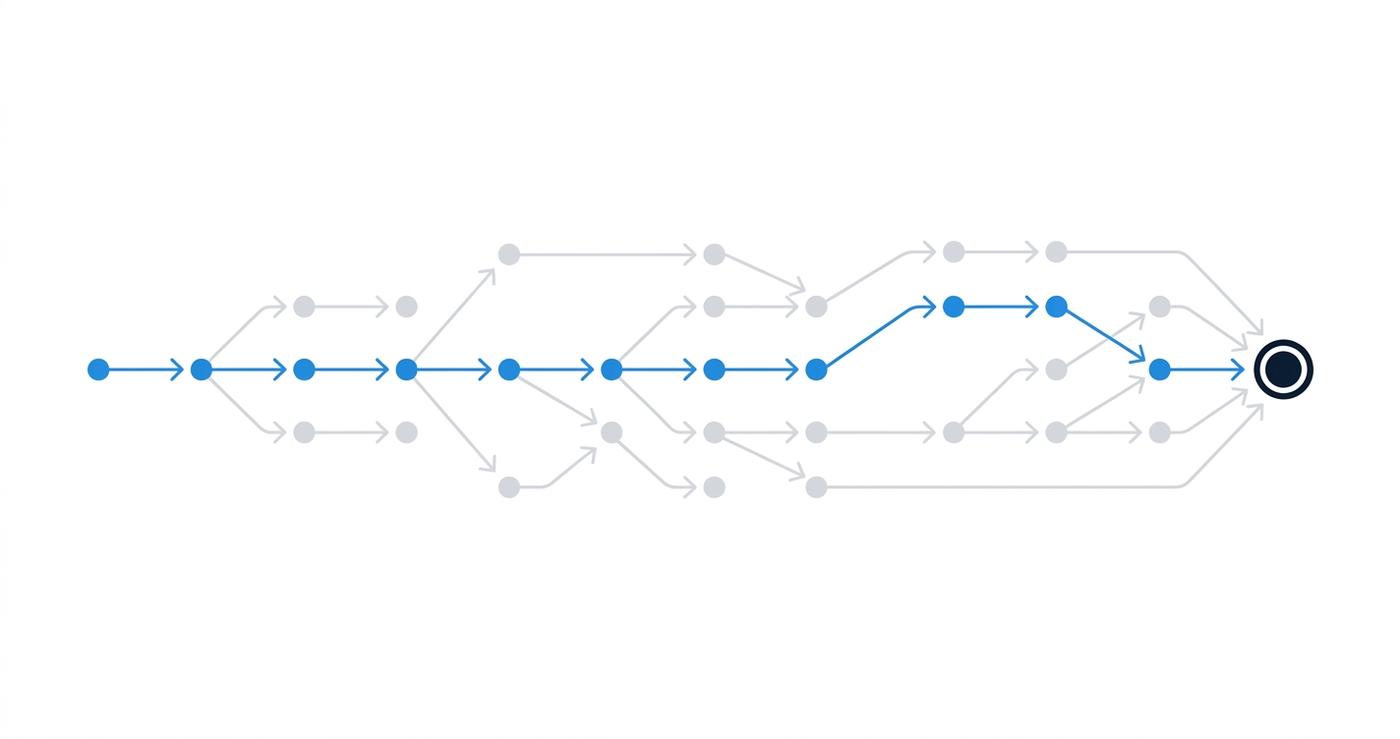
Marketing attribution is the most over-engineered metric in B2B SaaS.
I've watched founders spend $80K on attribution platforms to answer a question they could have answered for $0 by filling out four fields in their CRM. I've watched marketing teams debate the merits of W-shape versus position-based attribution while their underlying CRM data was 40% incomplete. I've watched VPs of Marketing get fired because a board meeting hinged on an attribution number that nobody could explain.
The problem isn't that attribution is unimportant. It's that the SaaS industry has confused measurement with modeling — and the modeling part is what most teams get wrong.
This is the practical guide to marketing attribution as part of marketing ROI for B2B SaaS: the five models you should actually understand, when each one is useful, why multi-touch attribution at $1M–$10M ARR is usually theater, and how to set up attribution honestly without buying tools you don't need.
What attribution actually is (and isn't)
Attribution is the process of assigning credit for revenue to the marketing and sales activities that influenced it.
That's the whole definition. Everything else — model selection, platform choice, sophistication level — is downstream of that one job.
What attribution is good for:
- Deciding where to spend the next dollar
- Identifying channels that are working and channels that aren't
- Telling a credible story to a board or investor
What attribution is not good for:
- Predicting future channel performance with precision
- Settling debates between marketing and sales
- Producing a "true" number that survives methodology changes
The mistake most teams make: they treat attribution like accounting. It isn't. Accounting answers "what happened." Attribution answers "what probably caused what happened." That second word matters.
The five attribution models you should understand
There are dozens of attribution models. Five matter at $1M–$10M ARR. The rest is academic.
1. First-touch attribution
How it works: 100% of the credit goes to the first marketing touchpoint that a customer had with your brand before becoming a customer.
Use it for: Understanding what's driving awareness and pipeline creation. Answers the question "where are new customers coming from at the top of the funnel?"
When it lies: Long sales cycles. If a buyer first encountered your brand on a podcast 18 months ago, then signed up after a Google ad last week, the podcast gets all the credit. The Google ad gets nothing — even though it was the conversion event.
Best for: PLG companies, founder-led GTM, brand-focused content programs.
2. Last-touch attribution
How it works: 100% of the credit goes to the last marketing touchpoint before the deal closed.
Use it for: Understanding what's driving conversion. Answers "what closed the deal?"
When it lies: Brand and content programs. If the customer was nurtured by 18 months of email + LinkedIn content and then converted on a paid search ad, the paid ad gets all the credit. The content program looks worthless even though it created the demand.
Best for: Performance marketing programs where the time from touchpoint to conversion is short. Default mode in most CRMs and ad platforms.
3. Linear (multi-touch) attribution
How it works: Credit is split evenly across every marketing touchpoint between first contact and conversion.
Use it for: A more balanced view of the customer journey when no single touchpoint deserves disproportionate credit.
When it lies: Everywhere. Linear attribution is the most reassuring and the least useful model. It says "all touchpoints matter equally," which is almost never true. A demo from your AE matters more than the 47th LinkedIn impression.
Best for: Companies that want a multi-touch view but don't have the data quality to support a more sophisticated model. Reasonable as a complement to last-touch, never as the primary view.
4. Time-decay attribution
How it works: Credit is weighted toward the touchpoints closest to conversion. Earlier touches get partial credit; later touches get more.
Use it for: Long-sales-cycle B2B where you want to acknowledge that early touches matter without giving them equal weight to closing touches.
When it lies: Same problem as last-touch but less acute. Still under-credits brand-building work.
Best for: Sales-led B2B SaaS with 3+ month sales cycles. My preferred default for sales-led motions.
5. Position-based (U-shape or W-shape) attribution
How it works: Credit is concentrated at specific stages.
- U-shape: 40% to first touch, 40% to last touch, 20% split across middle touches.
- W-shape: 30% to first touch, 30% to lead conversion (became MQL), 30% to opportunity creation (became SQL), 10% split across middle touches.
Use it for: When you have clean stage transitions in your CRM and want to credit specific lifecycle moments — not just the start and end.
When it lies: When your stage definitions are sloppy. If your "lead conversion" and "opportunity creation" stages are inconsistently applied, the model produces noise. Garbage in, garbage out.
Best for: Mature sales-led B2B SaaS with disciplined stage management. W-shape is the closest thing to a "correct" model for enterprise SaaS — when the data is clean.
Which model to use at which stage
There's no universal "best" attribution model. The right choice depends on your stage, sales motion, and data quality.
$500K – $2M ARR
Use last-touch + first-touch, side by side. Report both, don't blend them.
At this stage, you don't have enough data for a multi-touch model to be more than guessing. Last-touch tells you what's converting. First-touch tells you what's creating awareness. The two views together give you 80% of what multi-touch attribution offers, with 0% of the methodological debate.
Skip linear, time-decay, and position-based at this stage. They're not wrong — they're premature.
$2M – $5M ARR
Add time-decay as a third view. Keep reporting first-touch and last-touch.
By $2M ARR you typically have enough deal volume to support a time-weighted view. Time-decay gives you a reasonable "middle truth" between the two extremes. If first-touch and last-touch disagree wildly, time-decay tells you which side of the disagreement is closer to right.
Still skip platform-driven multi-touch attribution. The marginal accuracy isn't worth the cost yet.
$5M – $10M ARR
Now consider W-shape or position-based, if (and only if) your CRM stage management is disciplined.
By $5M ARR, the cost of inaccurate channel attribution starts to outweigh the cost of methodological rigor. W-shape attribution is genuinely useful for sales-led motions at this scale. But the requirement is firm: your CRM has to have clean, consistently-applied stages. If your team disagrees about when something becomes an opportunity, W-shape produces nonsense.
$10M+ ARR
You're ready for a real multi-touch attribution platform — Dreamdata, Bizible (now Adobe), or HockeyStack. Up until this point, they're overkill.
The first-touch vs last-touch debate (and why both matter)
Every marketing leader has a strong opinion on first-touch vs last-touch attribution. They're almost all wrong.
The "right" answer isn't one or the other — it's both, every month, looked at side by side.
Here's why: the delta between first-touch and last-touch attribution tells you something neither view shows on its own.
- If first-touch and last-touch agree on which channels are driving revenue, you have a tight, repeatable acquisition motion. Same channels are creating awareness and converting buyers.
- If first-touch and last-touch disagree, the most interesting marketing work is happening in the middle. Content, community, and brand are doing the work — and a different channel is getting the credit. This is where you most often see content programs underfunded and paid search overfunded.
The delta is the signal. Run both views monthly. Where they diverge is where you need to think harder.
Setting up attribution honestly (without buying tools)
You can get 80% of the value of a $50K attribution platform with disciplined CRM hygiene. Here's the minimum viable setup at $1M–$5M ARR:
On every opportunity in your CRM, capture:
- First-touch source — the channel that brought the lead to your site / first conversion event
- First-touch campaign — the specific campaign or content piece (if known)
- Last-touch source — the channel of the conversion event that created the opportunity
- Influence touches — a free-text or multi-select field for "other meaningful touches" (events, content, podcasts, partners)
That's four fields. Whether you're on HubSpot or Salesforce, this can be set up in a day. The harder part is consistency: every opportunity, every time, no exceptions.
Make it stick:
- Block your SDR/AE pipeline review on these fields being populated
- Make the opportunity creation form require them
- Audit weekly until it becomes habit
- Don't tolerate "I don't know" — it always converts to "marketing didn't do anything" in the eventual report
If you can't get to 95% completion on these four fields, you don't have an attribution problem. You have a CRM discipline problem. No attribution tool fixes CRM discipline.
When attribution platforms are actually worth it
Most B2B SaaS companies buy attribution platforms 18–24 months too early. The conditions that justify the spend:
- $10M+ ARR — below this, the marginal channel-level decisions don't justify the cost.
- Long sales cycles (4+ months) — short cycles can be measured cleanly without sophisticated modeling.
- High channel diversity (6+ active channels) — at 2–3 channels, a CRM-based model is sufficient.
- Dedicated rev-ops or marketing-ops headcount — without an owner, the platform becomes shelfware.
- A specific decision the current setup can't answer — "we want better attribution" is not a decision. "We can't tell if our podcast investment is paying back" is a decision.
If you don't have all five, you don't need the platform yet. Spend the budget on actual marketing.
A worked example: what attribution actually decides
Setup:
A $4M ARR sales-led B2B SaaS company has these channels active: paid search ($30K/mo), content/SEO ($25K/mo loaded), outbound SDR ($45K/mo loaded), podcasts/sponsorships ($8K/mo), community/events ($12K/mo). Total marketing spend: $120K/mo.
Last-touch attribution says:
- Paid search: 45% of new ARR
- Outbound SDR: 30%
- Content/SEO: 12%
- Direct/branded: 8%
- Podcasts: 3%
- Events: 2%
The board reads this and concludes: double paid search, cut podcasts and events.
First-touch attribution says:
- Content/SEO: 38%
- Podcasts: 18%
- Events: 15%
- Paid search: 14%
- Outbound SDR: 10%
- Direct/branded: 5%
The CMO reads this and concludes: the podcast and event programs are the demand engine. Paid search is harvesting demand that other channels created.
Which is right? Neither, on its own. The delta is the story.
Paid search shows up huge in last-touch and small in first-touch — it's converting demand that other channels created. If you cut podcasts and events, paid search's last-touch number drops within 9–12 months because there's no demand left to harvest.
The honest decision: maintain paid search spend, modestly increase content + podcasts, and instrument the delta more carefully. The board chart that "proves" paid search is best is misleading because of the model, not because of the data.
This is the kind of decision attribution actually makes. Not "which channel is best." But "where in the funnel does our marketing program actually create value."
Common attribution mistakes
Mistake 1: Reporting one model only
If you only report last-touch, you'll defund content. If you only report first-touch, you'll defund paid. Report both, every month. The delta is the conversation.
Mistake 2: Changing the model when the number doesn't look good
The most common form of attribution gaming: a marketing leader switches from last-touch to W-shape attribution in Q3, and suddenly marketing-sourced pipeline jumps 35%. The pipeline didn't change. The methodology did. Pick a model, stick with it, document it.
Mistake 3: Treating attribution as fact
Attribution is a model. Models are wrong on purpose — they trade precision for clarity. A confident "$3M of marketing-sourced pipeline" is always a methodology-dependent number. Say so in the deck.
Mistake 4: Multi-touch attribution at sub-$5M ARR
Multi-touch attribution at $2M ARR is mostly noise. Your data volume isn't enough for the model to be more than guessing. Stick with first-touch + last-touch until you have at least 24 months of cohort data and 200+ closed-won deals.
Mistake 5: Ignoring offline / dark social touches
Slack communities, podcast mentions, peer recommendations, sales team conversations — these don't show up in your tracked attribution. They're often the most important touchpoints. Use the "Influence touches" free-text field to capture them, and acknowledge them in the report. The buyer's actual journey almost always includes touches your tracking missed.
Mistake 6: Crediting marketing for sales-sourced pipeline
If the AE sourced the lead through their LinkedIn network and the marketing-sourced flag got toggled to yes, the marketing number is fake. Audit sales-sourced vs marketing-sourced classifications quarterly. The temptation to inflate the marketing number is enormous and the cost is credibility.
How attribution connects to the other ROI metrics
Attribution feeds the other metrics in the marketing ROI stack:
- CAC payback period — by channel — requires channel attribution to calculate. Without attribution, you only know blended CAC payback.
- LTV:CAC ratio — by channel — requires both channel attribution and channel-level retention data.
- Pipeline coverage — by source — requires attribution to decompose.
If your attribution data is dirty, every downstream metric is dirty. Fix attribution before optimizing anything else.
Frequently asked questions
What's the best attribution model for B2B SaaS?
There isn't one. The best practice is to report first-touch and last-touch side by side, every month. Add time-decay or W-shape as you grow and your data improves. The "best" single model is a myth.
Do I need a multi-touch attribution platform?
Probably not. Most B2B SaaS companies below $10M ARR are better off with a properly-configured CRM and first-touch/last-touch reporting. Multi-touch platforms add value when you have 6+ active channels, long sales cycles, and dedicated marketing-ops headcount.
What's the difference between first-touch and last-touch attribution?
First-touch credits the marketing channel that first brought a buyer to your brand. Last-touch credits the channel that converted them. Both are simple, both are partial. Comparing them tells you where in the funnel each channel does its work.
How do I attribute revenue to content marketing?
Content rarely gets last-touch credit and often gets first-touch credit. Track both, but also track "influenced pipeline" — opportunities where content was consumed at any point in the journey. Content marketing is almost always under-credited in single-model attribution.
What attribution model do attribution platforms use by default?
Most use "data-driven attribution," which is essentially a black-box machine learning model. It can be more accurate than rule-based models, but it's less interpretable and only works with high-volume data. At $5M ARR, you probably don't have enough volume for the model to outperform a well-instrumented W-shape model.
Should I use UTM parameters or CRM fields for attribution?
Both. UTMs capture the entry-point touch. CRM fields capture human-judged context (which campaign, which event, which influence). Relying on UTMs alone misses the long-cycle complexity. Relying on CRM fields alone introduces inconsistency. Use UTMs to populate CRM fields automatically, then have humans validate and supplement.
Where to go next
Attribution is the foundation underneath the rest of your marketing measurement stack. Get it wrong and every downstream metric — CAC payback, LTV:CAC, channel ROI, pipeline forecast — inherits the error.
The full system of marketing ROI for B2B SaaS ties attribution together with the other metrics that matter at $500K–$10M ARR.
If you want a framework for deciding what to invest in across the marketing program, the Market Leverage Matrix walks through which marketing investments matter most at each ARR stage — attribution included.
And if you want a benchmark on whether your current attribution setup is producing useful answers or just confident-sounding noise, take the free assessment — 15 minutes, you'll get a tailored read on where your measurement stack is leaking.
The companies that win at attribution don't have better models. They have cleaner CRM data and more discipline about reporting the same way every quarter. That's it.
More frameworks like this, straight to your inbox
Practical B2B SaaS marketing — no fluff, no filler. Unsubscribe anytime.
Ready to fix your GTM?
Get a free personalized assessment of your marketing program — benchmarked against B2B SaaS companies at your exact ARR stage.
Get your Matrix score -> Book a Call